


Types of Epilepsy

Focal, generalized, combined, or unknown—here's what those terms actually mean.
You can know that you have epilepsy without necessarily knowing what type of epilepsy you have.
That's because epilepsy isn't classified only by what a seizure looks like.
The International League Against Epilepsy (ILAE) separates diagnosis into different levels. One of those levels is epilepsy type.
There are four main epilepsy types:
Type of epilepsy | What it means |
Focal epilepsy | The epilepsy involves focal seizures arising within networks in one hemisphere of the brain |
Generalized epilepsy | The epilepsy involves generalized seizures |
Combined generalized and focal epilepsy | Both focal and generalized seizures occur |
Unknown epilepsy | Epilepsy is established, but there isn't enough information to determine whether it is focal or generalized |
1. Focal Epilepsy
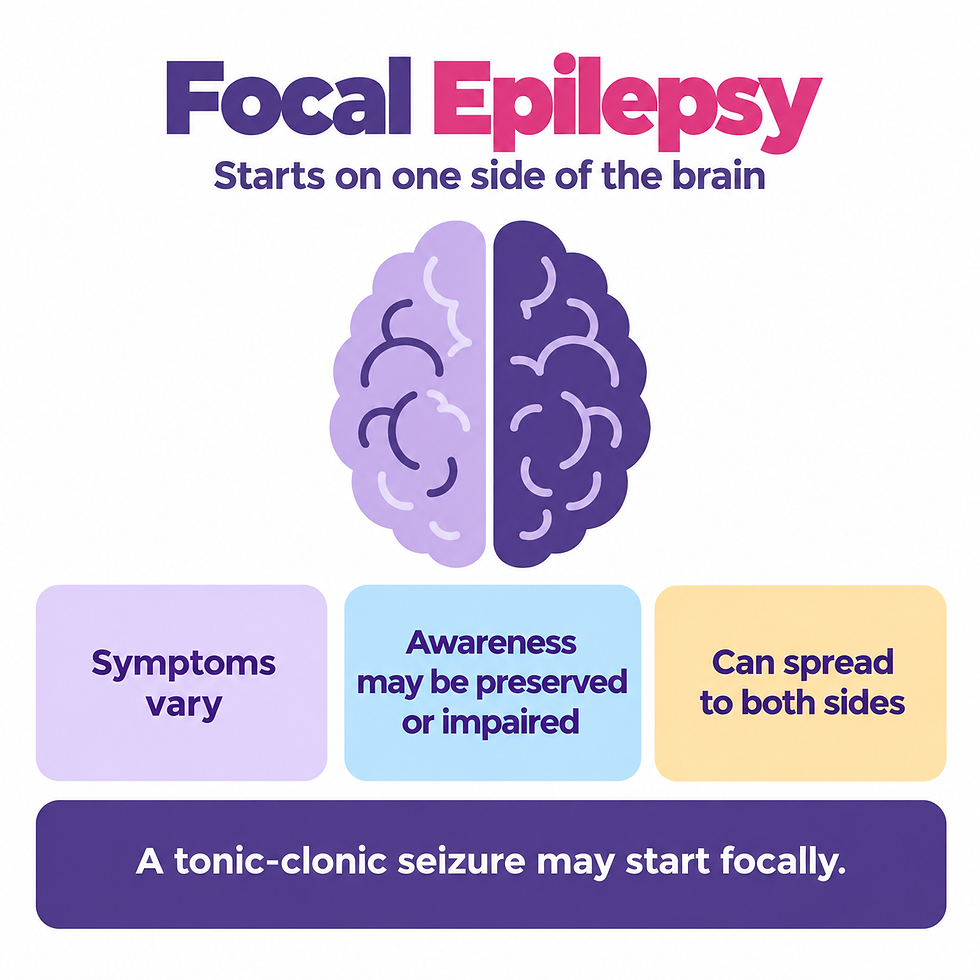
Focal epilepsy means that a person's epilepsy involves focal seizures.
Focal epilepsies can include seizures arising from one location, multiple locations, or networks within one hemisphere of the brain.
That does not mean every focal seizure looks the same.
What someone experiences depends partly on the brain networks involved.
Focal seizures can involve changes in:
movement
sensation
emotion
thinking
behavior
consciousness
A person may remain conscious during some focal seizures and have impaired consciousness during others.
Under the ILAE's updated 2025 seizure terminology, focal seizures can be classified according to whether consciousness is preserved or impaired, among other features.
A focal seizure can spread
A focal seizure can sometimes progress to involve both sides of the brain and become a focal-to-bilateral tonic-clonic seizure.
That means an important point:
A full-body tonic-clonic seizure does not automatically mean someone has generalized epilepsy.
The seizure may have started focally before spreading.
So doctors consider how seizures begin, not only what they eventually look like.
The ILAE states that focal epilepsy is diagnosed clinically and may be supported by focal epileptiform findings on EEG.
Remember it like this:
Focal epilepsy = focal seizures involving networks within one hemisphere of the brain.
2. Generalized Epilepsy

Generalized epilepsy means that a person has generalized seizures.
Generalized seizures are associated with seizure activity involving bilaterally distributed brain networks rather than beginning in a focal network within one hemisphere.
Generalized epilepsy can include several different seizure types.
According to the ILAE, these can include:
absence seizures
myoclonic seizures
atonic seizures
tonic seizures
generalized tonic-clonic seizures
A person can experience more than one generalized seizure type while still having one generalized epilepsy.
For example, someone might experience both absence seizures and generalized tonic-clonic seizures.
Those events can look dramatically different, but both can occur within generalized epilepsy.
What role does an EEG play?
Generalized epilepsy is diagnosed on clinical grounds.
The ILAE notes that the diagnosis is typically supported by characteristic generalized epileptiform activity on EEG, particularly generalized spike-wave discharges.
But EEG findings are interpreted together with the person's seizure history and other clinical information.
A normal EEG should not automatically be used to label someone as having generalized epilepsy simply because they have experienced a tonic-clonic seizure; the ILAE specifically advises caution in that situation.
Remember it like this:
Generalized epilepsy = epilepsy involving generalized seizures and generalized brain networks.
Focal vs. Generalized Epilepsy
The basic difference is easier to understand when they're placed side by side.
Focal Epilepsy | Generalized Epilepsy | |
Basic pattern | Focal seizures involving networks within one hemisphere | Generalized seizures involving bilaterally distributed networks |
Can consciousness be affected? | Yes | Yes |
Can seizures be subtle? | Yes | Yes |
Can tonic-clonic seizures occur? | Yes | Yes |
Can someone have several seizure types? | Yes | Yes |
Can EEG help with classification? | Yes | Yes |
So you generally cannot determine someone's epilepsy type simply by asking:
“Did they shake?”
How the seizures begin and the person's overall clinical pattern matter.
3. Combined Generalized and Focal Epilepsy

Some people clearly experience both focal and generalized seizures.
The ILAE calls this:
Combined generalized and focal epilepsy.
This category exists because not everyone fits neatly into only the focal or generalized group.
A person's clinical history may show both focal and generalized seizures.
Their EEG may also show both focal epileptiform discharges and generalized spike-wave activity, although the ILAE notes that epileptiform EEG abnormalities are not required to make the diagnosis.
Combined does not simply mean “many seizure types”
This distinction is important.
Someone with generalized epilepsy can already experience several different generalized seizure types.
Having multiple seizure types by itself does not automatically mean someone has combined generalized and focal epilepsy.
The combined category means that the person's epilepsy actually includes both focal and generalized seizures.
Remember it like this:
Combined generalized and focal epilepsy = both focal and generalized seizure patterns are part of the person's epilepsy.
4. Unknown Epilepsy

Unknown epilepsy is probably the most easily misunderstood of the four categories.
It does not mean:
“Doctors don't know whether you have epilepsy.”
The diagnosis of epilepsy has already been established.
Instead, it means there isn't enough information to determine whether the person's epilepsy should be classified as focal or generalized.
The ILAE gives examples of situations where EEG testing may be unavailable, normal, or otherwise uninformative.
A person with established epilepsy might also experience tonic-clonic seizures whose beginnings were not observed clearly enough to determine whether they started focally or were generalized from the beginning.
In that situation, calling the epilepsy unknown may be more accurate than guessing.
Unknown does not mean “unknown cause”
This distinction is especially important.
Epilepsy type and cause of epilepsy are different parts of classification.
So:
Unknown epilepsy type means there isn't enough information to determine whether the epilepsy is focal or generalized.
It does not automatically mean doctors don't know why the person developed epilepsy.
The ILAE treats epilepsy type and etiology, the cause or presumed cause, as separate parts of the diagnostic framework.
Can the classification change?
Yes.
“Unknown” describes what can be determined from the information currently available.
If additional clinical information or testing later clarifies whether the seizures are focal or generalized, the classification can become more specific.
Remember it like this:
Unknown epilepsy = epilepsy is established, but there isn't enough information to classify it confidently as focal or generalized.
The 4 Types at a Glance
Focal
The epilepsy involves focal seizures arising within one hemisphere.
Generalized
The epilepsy involves generalized seizures.
Combined generalized and focal
Both focal and generalized seizures occur.
Unknown
Epilepsy is established, but the available information isn't sufficient to determine whether it is focal or generalized.
That's the core framework.
Why Does Knowing Your Epilepsy Type Matter?
These categories aren't just vocabulary.
Epilepsy classification is a clinical tool.
The ILAE explains that classification helps clinicians understand the seizures someone has, what other seizure types may occur, possible triggers and prognosis, and can help guide treatment decisions.
In other words, identifying the epilepsy type can contribute to decisions about evaluation and antiseizure treatment.
That makes knowing your epilepsy type more useful than simply memorizing medical terminology.
Instead of only knowing:
“I have epilepsy.”
you might know:
“My epilepsy is focal.”
or
“My neurologist considers my epilepsy generalized.”
or
“My epilepsy is currently classified as unknown because there isn't enough information to determine whether it is focal or generalized.”
Each statement gives a more precise description of the diagnosis.
Don't Know Your Epilepsy Type?
You can ask your neurologist or epilepsy specialist:
“Is my epilepsy focal, generalized, combined generalized and focal, or currently unknown?”
A useful follow-up is:
“What findings led to that classification?”
That may open a conversation about your seizure history, EEG findings, and other information your healthcare team used to reach the diagnosis.
Four Types, Very Different Experiences
Epilepsy isn't one condition that presents identically in everyone.
Someone with focal epilepsy may experience seizures very differently from someone with generalized epilepsy.
Someone with combined generalized and focal epilepsy experiences both patterns.
And someone with unknown epilepsy has established epilepsy even though there isn't yet enough information to classify the broader type.
The simplest way to remember it is:
Focal: focal seizures.
Generalized: generalized seizures.
Combined: both.
Unknown: epilepsy is confirmed, but its broader type cannot yet be determined.
Four broad epilepsy types.
Many different experiences within them.
And understanding which type you have can help make the medical language surrounding your epilepsy a little easier to understand.
This article is intended for education and awareness and is not a substitute for individualized medical advice, diagnosis, or treatment.


Comments